The Choice Within: Chapters 1 - 4
Time — February 9, 1944; Honolulu, Hawaii, USA.
“Will you marry me?”
A deep dimple formed in her left cheek as she focused on writing: “Breath rate: 12; Temp: 98.7; Pulse: 95.” Then Lieutenant Jeannette Crawford glanced up into a pair of very attractive emerald eyes, twinkling like two Christmas wreaths.
Good, he’s not serious, she thought, letting a breath escape. The last boy who proposed was so earnest, it almost broke her heart to turn him down. So many soldiers hadn’t seen a female in a couple of years—or, at least, one that wasn’t for hire—that they fell in love with the first one that was kind, which was often the nurse who took care of them.
“I’m sorry, Captain Herbert, I’m already spoken for.”
Though partially true, the phrase wasn’t a rejection, which allowed for an honorable retreat. Buzzing from the overhead fluorescent lights filled the empty moment.
She pulled up the blackout shade a little higher, allowing more light from the late-afternoon sun. Tripler General Hospital didn’t have any view of the ocean or Diamond Head, but this side of the hospital faced north to the lush green Oahu Mountains, with their flock of White Terns, though sometimes called Fairy Terns, that seemed in perpetual motion. The boys on the other side of the aisle had this view, which broke up the white: white walls, white beds, white sheets and blankets, white pajamas, white floor… At least her wraparound nurse uniform had thin brown stripes.
“Where is he?” Herbert’s smile fell.
“Pacific.”
He never shared details. Which was better. This way, she didn’t create images in her mind. Based on the injuries she treated here in the hospital, detailed thoughts of what Nick could go through came easily.
Out of the corner of her eye, she saw Walters, one of the ward medics, wheeling Private Collins back in from X-ray.
“That covers a lot of water. What island?”
She shook her head. “Carrier based.”
A full grin formed as she wrapped the blood-pressure cuff around his left arm.
“What? You fell for a squid? That’s treason!” A smile belied his words. “Please don’t tell me he’s a fly-boy.”
A cock of an eyebrow gave her answer. Air whooshed with each squeeze. With the stethoscope in her ears, she correlated beats to the numbers on the dial.
“Oh, now, here I was thinking you were intelligent.”
“Now, now, now,” she turned the valve; the air hissed its way out, “you don’t want to insult a woman who gives the injections, do you?”
The captain burst outlaughing. “No, I don’t. I already hurt in enough places. The last thing I need is a new pain in my ass.”
“Your wounds are healing well. Soon, you’ll transfer to a rehab facility.”
“After which I’ll go back.” Shadows passed over his eyes.
“If you want to talk about it, I’ll listen.”
“If I told you, then you would have those memories as well.” His thick voice dropped an octave. “No one should have those memories.”
“It’s far better for you to let it out. I can take it.”
All teasing disappeared as his eyes latched onto hers. For a fraction of a moment, unspoken details paled as the impact bared itself. “I hope you never have to.” He closed his eyes, signaling that he wanted to be left alone.
She hooked the chart at the end of the bed and took her time walking back to the nurses’ desk. Glancing at each patient, she checked their faces, if visible, and tried to let go of the raw pain in those green eyes. Private Sutton sat up, reading. Lieutenants Keith and Clements were talking. Sergeant O’Neill and Jenkins were sleeping, thankfully; they both needed it.
“I had the seventh proposal,” she said to the nurse sitting at the desk, writing up the daily report.
“What? You broke my record,” said Lieutenant Grace McClure, Jeannette’s friend and roommate.
This was as much a surprise to her. Every day, she watched heads turn to follow Grace’s curvaceous body and cute strawberry-blonde bob hairdo. She couldn’t compete with her friend’s beauty—not that she had any interest in doing so.
In school, Jeannette always had male admirers. Her father had said it was her intense, chocolate-brown eyes that let the boys know she saw the real person, not the macho image they tried to put out. Her mother said it was her honey-brown hair and cute button nose. To her, it didn’t matter. With each of those boys, she methodically maneuvered them into the position of pal and onto the next girl. She was waiting for someone to come into her life. Then, five months ago, Nick came.
“Who was it?” asked Grace.
“The captain at the end.”
“The one with the gorgeous eyes? He should have asked me; I would have said yes.”
Jeannette shook her head, grateful for Grace. She always kept a balance.
“Speaking of great eyes, any news from Mr. Wonderful yet?”
“His letter came—”
She turned her head at the retching sound. “Call a doctor!”
Jeannette ran to bed four as vomit erupted. “Medic! I’ll support his head if you can roll him onto his left side. Ready? Go.”
The two held him in place until the purge subsided.
“Okay, bring him backdown. Stay here.”
Jeannette pulled up the eyelid that wasn’t covered in bandages. A large black orb stared out, seeing nothing. She placed her fingers on his carotid. His pulse was increasing, as was hers.
“What have we got?” Dr. Simmons asked, rushing up to the bed.
“Pupil is heavily dilated, rapid pulse, breath rate eight, but erratic.” With a clean corner of the sheet, she wiped his mouth.
“Get the resuscitator,” he said to the medic as he examined the patient.
Jeannette watched Dr. Simmons rub his knuckle over the patient’s sternum.
“No response, dammit. Here,” he handed the resuscitator to her, “give him ten to twelve breaths a minute while we wheel him to critical care.”
Grace cleared the path. Jeannette held the mask in place and pulled the bellow up, then down, in as normal a rhythm as possible, while she ran along with the bed. Her own pulse raced, more from fear than exertion.
“Dr. Simmons,” shouted Jeannette, when they turned into the main hallway, “I’m not getting enough air into him. His chest is barely moving.” Jeannette pressed his carotid. “His pulse is weak and slow.”
Fight, Danny.
Simmons grabbed the resuscitator and pulled, then pushed hard. The patient’s chest barely moved. He tried again. Nothing. With his stethoscope, Simmons listened to his heart. “His heartbeat is faint.”
Ticking from the wall clock was all anyone heard for a few moments. Nothing stopped time.
“He’s gone.” Simmons stood up and removed his stethoscope.
Though she had clung to hope, that simple statement wasn’t a surprise. “What do you think happened?” Her voice was low and soft.
“I’m guessing an embolism or an aneurysm—either of them with no damn thing we can do.” He said the last words with the same impotent frustration that she shared, hers mixed with guilt; the boy had been under her watch.
Dr. Simmons’s shoulders hung a little lower as he walked away.
“I’ll take care of him,” Jeannette said to Walters. “Would you please clean up the area around his bed?”
He nodded.
“Walters, thank you for your help.”
“I wish it would have been more.” He shook his head as he walked off. Jeannette watched him leave.
Now alone in the corridor, she turned to the boy lying on the gurney. Thankfully, his eye was already closed; the final stare she saw so often was maybe the hardest part. But, then again, there were so many hard parts to this job. Moving his straight, brown hair away from his face, she ran her fingers down his smooth cheek. No stubble at all. So young, she thought, as were most of them. What little color his face had drained away. His spirit was now on to Heaven.
“I’m sorry, Danny. I’m sorry. No more fighting. We’ll notify your parents.”
Jeannette folded the soiled portion of the sheet and drew the clean part over his head. On the clipboard, she filled in the information, not bothering to look at the dog tags. She knew his name, as she did for all of them. Sometimes it was all she could do for them. She had met Private Daniel “Danny” Jenkins two weeks ago. Though he regained consciousness a few times between the two surgeries, he just didn’t have the strength to fight anymore. A medic walked up as she signed her name on the form.
“Is he ready?”
“Yes, he is.” Jeannette handed over the file and watched Danny being rolled out of sight.
“Why don’t you take your break now?” said Grace, when she walked back into the ward.
“It’s your turn.”
“I’m hoping to leave a little early today. I have a date at the O club, and I’d like a few extra minutes to clean up. Besides, you need a break now.”
Jeannette nodded and walked down the hall, mentally replaying all of her actions today, trying to find the one that she missed with Danny.
At the entrance to the ambulance drop-off, Dr. Cross and DeeDee were hopping from new patient to new patient. Dr. Cross triaged and barked orders, while DeeDee wrote up tags and directed medics to deliver them to the respective ward. Patients outnumbered the staff by a large margin.
Jeannette jumped back to clear the way, watching a medic wheel away a female patient. Female casualties came in from time to time, but weren’t normal.
“DeeDee, what’s up with her?”
“Nurse from an aid station. They think she might have cerebral malaria. She’s going into the isolation ward.”
“I hope they’re wrong.” Of all the diseases that Jeannette treated, cerebral malaria was the scariest and took the most lives with it.
“Me, too. Since you’re here, will you please escort this nice man to your ward and get him settled? Here’s his tag.”
“Do you need me to come back?” Jeannette caught the gentle breeze that rushed in with the next round of patients. Though mixed with exhaust fumes, the sweet smell of flowers was a welcome addition to a room filled with blood and infections.
“No. I’ll be sending more your way.” DeeDee moved to another incoming litter.
Jeannette pulled over a wheelchair. It was nice to see an ambulatory patient for a change. However, no patient could walk in the hospital unless a doctor ordered it.
“I can walk,” the lieutenant said, his tired eyes defiant, but the amount he swayed on his feet told a different story.
“Well, of course you can, but are you going to deprive me of the opportunity to drive you in comfort? I promise, no wheelies.”
One side of his mouth tilted up. “I can’t turn down a pretty girl. And I wouldn’t mind the wheelies, but the other patients might get jealous.”
“You’re right: they would.” She placed her hands under his elbows to guide him down and helped get his feet up onto the foot pedals. “So, what’s your name, Lieutenant?” Practice had taught her that friendly questions drew out more information about what happened.
“Morris Stout.”
“Welcome to Hawaii. What brings you here?” She kept her voice light and upbeat as they maneuvered through the new wounded, trying to ignore the moans and focus on her new patient. His body didn’t show any outward injuries, but his skin hung down his face and around his arm bones.
“One of those bastard Zeros shot us down. My co-pilot and I had to take turns in the raft for a while. Not sure how long. It took a while, but they found us.”
Jeannette followed his words, piecing together a preliminary list of what he endured: exposure, malnutrition, exhaustion, trauma, and depression.
“Your co-pilot?” She switched to her nurse voice, the one that said: “I’m in charge and will take care of you.”
“Didn’t make it.”
The universal phrase that carried so much meaning. She added guilt to her picture.
“Well, Lieutenant Stout, we have a dry, warm bed that will stay in one place, plenty of good food and water, and a lot of time to sleep. How does that sound?”
“Great. Thank you.”
Grace looked up as Jeannette rolled in. “Lieutenant Stout, may I introduce you to Lieutenant McClure? She and I are your day nurses.”
“Bed four is ready for you,” Grace said, smiling.
Jenkins’s bed.
Jeannette caught her breath. Stop it. It happens in hospitals. Guys come in; guys go out. Focus on the new patient.
“Sounds like a table at a restaurant,” Stout said, with a weak smile, as Jeannette pushed him on. “Any chance at a table for two?”
“No chance at all. But we have ice cream.” The jokes and innuendos no longer phased her. If a guy didn’t joke around, she worried about his mental health. In the end, they all took the gentle rejection in stride.
“Not as good, but I’ll take it.”
“Here you go. You have a lovely view of the mountains.” Jeannette got him settled and started a fresh saline IV, per the instructions on his chart, which also gave a summary that the men had floated for almost two weeks. They must have had rain for water or they would have been dead. With rain, they probably also experienced storms and rough seas. I wonder when his friend died.
She left him asleep, to help with the new patients coming through the door. It seems all forty beds will be full tonight.
“Now you can take your break,” said Grace. “The medics and I can handle this for a while. I suggest going out a different way.”
The Sōkeisen — Hirohito 19, February 9; Tokyo, Japan
Why is he here?
“Akira!” shouted Uehara Tetsuo. “Look—”
The ball slammed into his right shoulder the moment he turned.
“—out!”
Akira Tanaka grimaced, rubbing his shoulder, before he picked up the ball and threw it back to his friend. All over the field, young men threw balls to warm up. A sort of symphony played: gentle and hard thumps as the balls hit the various gloves, mixed with the metal-on-metal ringing sound made by the hammers pounding in stakes to hold down the sandbags, while birds sang along in the background. He wanted very much to go back and join the fun. Instead, he straightened his back and walked toward the short fence that surrounded the field.
Maybe he isn’t here to take me home. Far worse possibilities entered his mind. Could something be wrong with his mother? He ran to his father.
“Father, is everyone well?” he asked, when he was close enough to be heard.
“Yes,” said Takeshita Tanaka, “the family are all well.” There was a brief softening around his mouth. Though not so much in his honey-brown eyes—or, at least, what Akira could see of them under the brim of his dark-brown hat, pulled down low.
“So,” he asked, looking around the field, “is this how my son spends his Saturday mornings?”
When I should be home working the fields with you? Words his father had made clear before Akira left home at break. As always, he kept his thoughts and desires to himself.
“I thought you said they canceled the season?” His father’s eyes followed a ball as it floated from one player to another.
Akira understood the irritation in his father’s words, yet surprised to see the older man’s eyes droop. To be here this early, his father would have had to get up two hours earlier than normal. His dark, herringbone suit, out of place in the dirty baseball field, would soon be hot if those clouds stayed away. He gave his father some credit for his effort.
They shared the same height for the last two years, yet Akira still lacked the muscular shoulders his father had from years of working the farm. Students don’t exert themselves that hard.
“They canceled this season and next year’s season. Two of the seniors organized this. They wanted an informal game before the school year ended.”
Takeshita’s left eyebrow shot up. “An informal game with Keio University?” His voice was full of sarcasm.
How does he know? There were no uniforms; all the players wore old clothes, beaten and torn through the years of work or sliding in the dirt. Ball caps, also old, bore no school emblem. Akira’s own faded blue pants were ripped in both knees, and his dingy, white button shirt stained various shades of green and brown.
“Did the school administrators approve this event?” The words came out as a question, but the meaning was an accusation. The game could cause definite trouble if discovered.
“I do not believe so. They asked us to keep it quiet.”
War was the reason behind the clandestine activities. The military drafted many players and adamantly insisted that baseball was an American pastime, which distracted from the war’s seriousness.
Takeshita glanced around at the growing number of spectators. “I believe that part failed. Well, inviting your uncle to umpire should help if they find out.”
They both turned to look at Sugihara Tanaka, surrounded by players from both teams, laughing and signing baseballs. A former star shortstop for Waseda University, back in the late 1920s, who went on to play for the Tokyo Kyojin, until he retired two years ago, he was now Kyojin’s infielder coach.
Oh, that is how he found out.
“I hope, for all of your sakes, that the students behave themselves this year. Good luck,” he said, then turned away to take a seat on the wooden bleachers.
Did he mean good luck with the game or good luck keeping the students under control? But he refused to ask that question. His jaw clenched all the way to the dugout.
Although Akira would not say so, he also hoped everyone would contain their spirit. Because of inappropriate behavior from student spectators during and after the game, the schools canceled the annual game for several years. Today, such spirit could be disastrous.
“Are you alright, Akira?” asked his uncle. Sugihara wore black pants and a white Kyojin shirt, displaying the shield with an orange outline of the name “Tokyo” and the red sun. He also had his black Kyojin cap. Together, he looked like a baseball professional suitable for the umpire position.
“Yes. Did you tell him about the game?”
His uncle nodded. “Underneath my brother’s hard exterior, he would want to come to watch you play in the Sōkeisen. Now, go join your team.”
Once inside, Akira looked around to count heads. “Where is Hatanaka?” he asked the group.
“He has left the school,” said Uehara, in a low voice.
All heads turned to him.
“Did he receive…?” asked Akira.
Uehara nodded.
“But there are only three weeks until graduation,” said Akira, his eyebrows drawn down. “Was he not allowed to finish?”
Again, his friend just shook his head.
Reality was a harsh intruder on the day. Another friend gone.
“Teams, please assemble so that we may begin the game,” called Sugihara.
Uehara, acting as captain, gave out the assignments, and the group formed a line parallel to the Keio players shooting out from the batter’s box toward the pitcher’s mound, with Sugihara standing in between.
“First, as I am the umpire, all of my calls are final. I will not accept contradictions.
“Now,” he said, speaking in a loud, commanding voice that reached beyond the teams, to the spectators on both sides, “Keio University established baseball fifty-six years ago. Together with Waseda, your programs became the model and foundation of Tokyo’s Big Six League. Every year, thousands of people follow your annual rivalry…” he paused, glancing around to both sides, “…until last year.
“While we are not in the traditional, majestic venue of the Meiji Jingu Stadium, today we play in this simple ball field, enjoying these rare warm hours that the natural world has given us. A gift to treasure. A moment in time to keep traditions alive.
“However, today the rivalry is not a contest between longtime opponents. It is a celebration of your schools’ history. An opportunity to honor the game that we love. To honor those who cannot be here to play with us. To honor each other. Today, we play with one heart, that which we share with our ancestors through the millennia. Today, we are the heart, the love, the joy of Japan. At the end of this day, the score will be irrelevant; all that matters is that we play with honor.”
Akira stood watching his uncle walk off, unconcerned with so many eyes following his steps. His words had elevated this game to some higher level, bringing security and a calm relaxation to his muscles. A warmth spread through him, yet bumps formed on his arms. His eyes scanned the other players, and their facial expressions reflected the wonder of his own feelings. The players all came out of their reverie and smiled at each other.
Excitement surged around the field as Waseda, the home team, took the field.
Akira played right field. He was a good fielder, but not a strong batter. During the 1942 season, though thrilled to make the team, he sat on the bench most of the year. If Hatanaka had been here today, I would be on the bench.
With the cancellation of the seasons, they had not maintained the field. However, in late winter, the light-brown grass showed signs of light green. A small, gray feather lodged itself between some blades. Patches of weeds grew in the baselines, but not so large as to cause any problems.
Keio’s first batter surprised Akira. If Ozaki is batting first, who is their cleanup hitter? He ran backwards to be ready. The batter stepped up to the plate.
Horiuchi, a very experienced pitcher, threw the first pitch wide, to the left.
“Outside,” yelled Sugihara.
The pitcher dug his shoe into the mound to create a deeper divot before the board. He wound up, kicked his leg out and, as his body fell forward, released the ball. Ozaki swung and hit a hard grounder to the third baseman, who picked it up and threw it to first.
Sugihara ran partway to first and threw both arms out. “Safe!” he yelled, after the batter touched the bag. It was such a close call that, under normal circumstances, the coach would have raised a question.
As everyone was resetting their positions, Ozaki walked back toward home plate. “Honorable Umpire, I understand you called me safe. However, the baseman caught the ball before my foot touched the bag. Please accept this one contradiction,” he said, with a bow.
Sugihara gave a low bow and held it for a few seconds longer. Then he stood back up and smiled. “Runner, you are out.”
Ozaki smiled and walked back to his dugout. A couple of his unhappy team members questioned his action, but the rest nodded.
That simple act of honor set the stage for the rest of the game. Players helped to make close calls. Both sides cheered good plays.
Evidence of the year-long absence from competition was clear on both teams: pitchers threw far more outside balls than center balls, bouncing ground balls missed and throws to bases went wild. But both teams accepted these mistakes without reprimand. The teams played with joy and freedom, rotating through the full rosters so that everyone played. Gone were the tense moments, the fear of failure. Spectators smiled and laughed.
Inning after inning, Akira watched this continual display of joy, not caring if a ball came his way. He enjoyed watching the plays, the pitches, the secondary game of daring between pitchers and runners trying to steal a base. It was a soft day, suited to a casual game. It all reminded him of when he had been a boy, just learning the game, playing with his friends in a field: no backstops; broken pieces of boards put down as bases, which never stayed in place; ants crawling in and out of their hills, in the line to third base; finding reasons to slide; and the days ending with good-natured arguments on close—and not-so-close—calls.
Late in the eighth inning, a loud crack of the bat and the crowd yelling signaled Akira. His eyes found the moving white speck soaring his way against the blue-and-dark-gray background. Gauging by its speed, it would fly behind him on the left. His eyes glued to the growing speck, he ran both backwards and sideways. With his shorter height, his only chance was to jump for it. Throwing himself forward, extending his left arm, he closed his glove around the ball. After the entire length of his body hit the ground and bounced, he rolled over, holding his glove in the air, then scrambled to his feet to throw the ball to the second baseman, who had come out as the cutoff man. The batter was out, but the runner on first made it to third, then held up. The last out came as the next batter popped up a fly-ball to the shortstop.
Clouds that had built now blew in faster, blocking the sun. As the ninth inning started, the score was four to three in favor of Waseda. With the first batter came fat raindrops, but no one wanted to quit, so the game played on; Sugihara took a break to get a waterproof cover from his bag, then called for the game to resume. Dirt turned to mud, wind blew off hats, runners slipped and fell, and fly-balls mixed in with the downpour were hard to see.
Keio’s second batter hit a single and made it to second base because of a wild throw to first. The catcher missed the next pitch, allowing the runner on second to steal third, spraying the baseman with mud as he slid. Then the batter bunted down the third-base line. The basemen looked the runner back, then threw to first, but the throw was late; the man on third scored.
Lightning flashed close by, sending everyone for shelter. Sugihara called the game off, leaving it to endless future arguments about what the outcome might have been if Waseda had had their last bat.
Akira and his father sat in the closest dugout. Sugihara took shelter in the other one, appearing to sign baseballs again. Tension between the two men smothered the fun of the day. How Akira wished he had the freedom to share his heart with his father. To reminisce about the minute details of the game, extending the fun for the rest of the rainy afternoon. But all he could think of was to repeat an earlier question.
“How are Mama and Suni?” he asked, glancing into his father’s brown eyes, before looking out into the rain.
“They are both well. Your grandmother was not unwell; it is nothing serious,” he added, at Akira’s frown. “Your mother is looking after her. Suni is working today.”
At the mention of his younger sister working, Akira’s stomach contracted. Because of his uncle’s financial help and his own good grades, he could go to university. However, the family farm did not earn the money for his sister to continue her education. Once Akira graduated next year and obtained a position, he hoped he could not only contribute funds to his family, but also afford pay Suni’s school tuition, if she wished to go, and if her father approved.
“Are you corresponding with Miki?”
Akira nodded. “I sent her a letter two weeks ago. She has yet to reply.” He turned his head to look back out at the clouds. Miki was another issue between them. His parents had arranged their marriage many years ago. Akira was torn because, in truth, Miki was beautiful and he enjoyed her company; the contention that he was not allowed to find his own bride, to marry for love, ate at him. To break the agreement would bring more dishonor to the family. It seemed that everything Akira wanted and dreamed of would bring dishonor to his family.
“The mail is slower these days. I am sure you will get a letter from her soon.”
Intent on changing the subject, Akira looked at his father. “You look nice in your brown suit. I appreciate that you came. Can you stay long?”
Takeshita checked his watch. “No. I will need to leave in less than an hour. I obtained a ride in a delivery truck this morning, and the driver will pick me up in front of the school on his way home.”
Sugihara came into the dugout at the right time. It amazed Akira how exhausting it was to make small talk with his own father.
“Is there any ink remaining in your fountain pen?” asked Takeshita. For the first time, the older man’s face showed some true amusement.
“Yes. Would you like me to sign a ball for you?”
Takeshita shook his head but kept his smile.
“The rain is easing. I believe we should go back to school so that Akira may change into clean, dry clothes.”
Akira led them out, forcing himself not to run as fast away from them as he could. He wondered if his father had any idea how much it hurt to watch the casual camaraderie between the brothers, and none existing between the two of them. Why was it so easy to accept his younger brother’s choice in careers, but not his own son’s choice?
Once they made it to the school, Takeshita looked at them both. “I will remain here in the event that the delivery man comes early.”
“Will you wait until I come back to say goodbye?”
“If you hurry.”
Akira ran up the stairs, unbuttoning his shirt on the way. Once inside his room, he yanked off clothes, dropping the wet ones wherever they landed. Never had he changed so fast, finishing the buttoning on the way down the stairs.
His uncle laughed when he saw Akira. Even his father had to smile.
“Akira,” asked his uncle, “was that a record?”
“I think—”
A honk of a horn interrupted. Akira’s heart contracted at the sound. Out of time. Words left unsaid. Emotions unhealed. Space between them grew.
Father and son stood looking at each other, neither knowing what to do. Takeshita broke the tension and took a step forward, putting his arms around his son. Akira reciprocated, but the mechanical embrace allowed only the briefest of touch.
Takeshita turned and opened the exterior door. Looking over his shoulder, he gazed briefly at Akira. “That was a good catch today.”
An Opportunity
Three steps out the front door, Jeannette stopped and inhaled the zesty, slight peachy scent of the gardenia trees that scattered around the grounds. Though Grace argued with her, she also noted a hint of coconut from the flower. The calming aroma almost replaced the antiseptic odors embedded in every fiber of her not-so-clean uniform.
A path led a short walk to her bench. At least, it was her spot for every break that Mother Nature allowed—and, in Honolulu, the grand lady was very generous. The bench sat on a dense, grassy area under a large monkey-pod tree. Last summer, its pink blossoms had formed a twenty-foot-wide umbrella; tiny buds now hinted at the next bloom. Jeannette had sat under this tree at almost every hour of the day and night. On the hardest days, if she could, she arranged her schedule to come out at sunset or sunrise, to absorb its energy and share in its animation, as its leaves closed for the night and opened to the sun.
Today was another perfect day, except for the construction pounding nearby. Grace told her it began the day after Pearl Harbor and it hadn’t stopped. Fort Shafter was the Pacific headquarters of the Army. They nicknamed the newest building under construction the “Pineapple Pentagon”. Close to it, they filled in a large fishpond for some needed flat space, probably a parade ground.
In just over two years, engineers had thrown up many identical plain and versatile buildings, expanding the hospital from 450 to the current 563 beds, and adding more. Last month, they had broken ground for a much larger hospital, which would sit up on the foothills, with a spectacular view of the ocean. And the rumor mill said it would be pink, like the Royal Hawaiian Hotel.
Fresh out of nursing school, the Army Nurse Corps sent her here. In her orientation, they stated that the mission of the hospital was to provide a space for solace and recuperation, and it did; her time here had been the most amazing experience she had ever imagined. For most of that time, she worked seven days a week, twelve-hour shifts, with a day off once in a while. The war provided the best medical education—at the expense of the men. She wished so much that this wasn’t the case, but her own nursing school in no way prepared her for the diversity of need that she had seen here. During school, she rotated through the various wards. Here, she shifted as needed by the casualties and the staffing required to meet those needs. Beds were not the only area that needed to grow; staff was another. New personnel came in regularly, but the wounded and ill came in faster.
One of the first surprises was treating frostbite cases from the battles in the Aleutian Islands. The next day, she learned to treat jungle rot from the South Pacific; most were on the feet or legs, though she understood it could grow anywhere. Like frostbite, it is painful and can lead to amputations if not treated quickly. And few had that option.
Beyond those, battle wounds, burns, construction accidents, malnutrition, exposure, common illnesses, and diseases she had never heard of all passed through their wards.
But, for her, the hardest to treat and see were the psychiatric wounds. Everyone who came into a hospital had some level of mental trauma, but war created its own category.
Mixed in with her medical education was a crash course in the Army regulation of every facet of life. Only in the last few months had she become comfortable with what she was doing, and now could help the new nurses.
She took the letter out of her pocket and ran her fingers over the words. Please be good news…
Dear Jeanne,
I miss you so much!
Today is New Year’s Day and the first day off from work in what seems like an eternity. I can’t explain it, but time doesn’t seem to work the same over here. Except for New Year’s Day, I think we’ve worked every holiday. Some guys have renamed our ship the Holiday Express. We try to see the humor, even if we have to create it.
Hi, back again. James called me away to come play poker. I need to stop playing with them, as I don’t seem to be any good at the game. The challenge is there are only so many things to do on a ship surrounded by the ocean. When we get to go to a base, it’s better. I’ve read most of the books in the library and played a lot of basketball in the hangar. I’m not complaining. If I could just fly around, that would be great. But my job doesn’t allow that.
The most fun I have is thinking about you and our time together. I’m still embarrassed by my actions in the car. As a pilot, I’m supposed to be observant. My only excuse is that I was so blinded by your beauty, I didn’t look to see that the window was closed.
The nights we walked along the beach are my favorite memories to replay. And staring at the stars at night takes me back there.
I’m so glad you’re safe in Hawaii and hope I’ll be back with you soon.
Nick.
He’s safe. With that, her body relaxed.
She looked up at the tree limbs swaying. Green leaves and blue sky became more vivid. Rhythmic whistles from a red cardinal softened to a melody. She reread the letter three times. Her smile grew bigger with each read.
Several jeep ambulances drove up the road, signaling that a new batch of casualties had just landed and her break was over.
Grace met her in the hall, with pinched lips and narrowed eyes; a look Jeannette had seen on her friend’s face many times before.
“I came to relieve you. Why are you in the hall?”
“Major Knox asked me to stay and to find you. There is some meeting that we have to attend,” she said, with a huff.
“What about the ward?”
“She had the next shift come in early.”
Jeannette’s eyebrows shot up. Knox never did that before.
Cooler air sent chills through her, as she entered the conference room and took an open seat in the back, behind several of her fellow nurses. An army doctor leaned against a table at the front of the room.
“Is this all?” he asked Major Knox.
“Yes. The others are on duty. I will transmit your information to them after their shift.” As always, their head nurse was all business. Even though the doctor outranked her, he was wise enough not to question her.
He nodded and stood to address the group. “Thank you all for staying. I am Dr. Frye, and I am here to extend an invitation to an immensely valuable opportunity. We are outfitting a new hospital ship, and it is almost ready. I’ve been involved with the design, which will include three full surgical suites, X-ray, laboratory, a dedicated dietary kitchen with dietician, seven hundred beds, and clinics for dental, eyes, ears, nose and throat.”
On a ship? That’s more beds than we have here.
“We’re taking the fight to the enemy, and we need the medical support to do this.” Frye shifted his eyes to span the entire group. “This ship will join our existing force, along with new medical staff, who will man station hospitals on key island locations. This is an integral component within a comprehensive plan, to provide immediate advanced care to our guys.”
Jeannette sat up straighter. Advanced care at the point where they need it. That will cut out the travel time.
“The USS Comfort is going to be a beautiful and, as her name suggests, very comfortable ship, not only for the patients, but also for the staff and crew. It is the first ship to combine the marine expertise of the Navy with the immense medical skill of the Army.”
“What does that mean?” asked DeeDee.
“The Navy will run the ship and the Army will run the hospital.”
“Would we have any reporting requirements to the Navy?” asked Jeannette.
“No. All aspects of your assignment will only report up to the Army Senior Medical Commander, just as you do here. Your staterooms will be comfortable and the food will be very good—no rations; those Navy boys on the ships eat well. Comfort will have movies, a library, and a deck isolated from the enlisted men, so that you can enjoy some downtime in the sun.”
“You said advanced care,” Grace said, her eyes still narrowed; “how close to the battles will this ship go?”
“First, all painting, lighting, and flag designation will comply with the Geneva Convention; the entire crew will also fall under that protection. Second, we intend to keep the Comfort well away from the battles, until the initial landing areas are secure and the fighting moves inland.”
“The nurses in Bataan were supposed to be protected under the Geneva Convention, weren’t they?” Grace pointed out, in a steely voice.
Jeannette, like every nurse in the Army, had heard about those nurses stationed at a hospital in the Philippines, before the war broke out. Though a few women escaped, the Japanese imprisoned seventy-seven of them when they overran the islands. No one knew where they were now.
Dr. Frye lost his initial exuberance. “Yes, they were,” he said in a lower voice, then took a deep breath. “This is war; I can’t promise you that these missions will be absolutely, without a doubt, safe. These ships are not intended to be put into harm’s way, but will harm’s way come on its own? It is a possibility.” He paused and looked around the room, making eye contact with each woman.
“Our boys deserve the best and fastest help we can give them. This opportunity is of immense importance and comes with risk. I won’t lie to you about that. It also requires the right personnel, who have the strength to handle the diversity, constant surprises, weather, fear, as well as the raw emotions of those wounded and scared. What I can promise is that your value will be immeasurable, and you will witness history firsthand.”
Again, he paused. “This is a volunteer decision, and we are only looking for another couple of nurses; we have already assigned the rest. I will leave tomorrow before noon, so I need anyone who wishes to join to give me your answer in the morning. Thank you for your time.”
No one spoke as they left the room.
“Finally,” said Grace. “Let’s get out of here while we can.”
Jeannette followed her, lost in her own thoughts.
Red Card
Akira followed his father out and stood watching, until the truck was out of sight, glad that his father could not see the tear running down his cheek.
Sugihara put a hand on Akira’s shoulder. “Come with me. You and I will go out to a late lunch.”
The two walked in silence for three blocks. Streetcars rumbled alongside. Clouds still covered the sky, but the rain had stopped. Sugihara led them to The Tea House.
Only one table held customers; fewer people had the funds for the luxury of eating at a restaurant. A young woman in a white shirt and light-blue monpe pants directed them to a table. She left and returned with a pot of hot green tea.
“Harusame soup is available today, if you would like it.” She said it with her eyes down, which Akira took to mean that was all they had available.
“We would like the soup, thank you,” said his uncle. “Also, would you bring us hot sake?”
The young server brightened. “Yes.” She bowed as she left.
Wonderful aromas floated about the room, which triggered Akira’s stomach to rumble, announcing his hunger, causing his uncle to laugh. Akira looked around. The tea house had many windows but, with the weather, it was still dark inside. A candle, surrounded by a tall, frosted-glass vase, burned in the middle of the wooden table, providing extra light.
“You worked up an appetite. You played well today. That catch in the eighth inning was very impressive.” He took out a baseball and handed it to Akira, along with his fountain pen.
Akira could not stop the smile that formed. Praise from his uncle was rewarding, but the request to sign a ball was funny. Going along with the joke, he signed his name. “It is hard to write on the curved surface. How do you do this so well?”
“Practice.”
The soup was served, followed by the hot sake. Akira filled the sake cups, handing one to his uncle. Raising his cup, he smiled at the man who had been so important to his life. “Kanpai,” he said, in toast.
“Kanpai.”
Akira admired the presentation of the bowl. The cook had taken time to arrange the tofu cubes and wakame seaweed around the fluffy eggs. Portions were generous, and the vegetable broth with green onions was so flavorful. He also detected a hint of sesame and soy sauce.
“So, what happened between you and your father over your break?”
Akira took a moment to organize his thoughts. “He wants me to come home to help him. I understand; he, Mother and Suni do all the work. I help when I can, during the school breaks. The problem is that I do not want to work on the farm.”
“What do you wish to do?”
Someone finally asked. An internal wall crumbled. Every dream he possessed tumbled out: “I want to travel and see the world. To sail on large ships, like you did, and visit America.” His hands began moving, animating his words. Arms spreading out invited the world into his life. “To visit the castles of Europe, to see their artworks, and walk on the beaches under swaying palm trees, on tropical islands. I…”
The light that shone so brightly throughout his words faded, as he returned to his reality. “But, as the only son, my responsibility is to take over the farm and take care of my family.” His head hung with the last words.
“You say like me but, Akira, the only way I could take those trips was because the university and Kyojin paid for them; I cannot afford them on my own. Even if I could find the money for my ticket, I could not take my wife and son; traveling is very expensive, and teachers do not earn the salaries for such luxuries.”
Akira looked up, his eyes burning at the betrayal. “So, I should give up my dreams? Do my duty?”
Sugihara shook his head. “No, never give up your dreams. Find another way to achieve them. Perhaps there is another path forward, which will help with all of your problems.”
Intrigue replaced Akira’s anger. “How?”
“Now, just listen to me. Teachers do not earn enough money, but businessmen do.”
“What business do you suggest?” asked Akira, turning his palms up.
“Go to your father—not as a son, but as a man with a university education. Pursue a partnership with him and grow the existing business into a large one.”
Akira shook his head.
“Stop and think, Akira. Businessmen travel to find new technologies, more efficient processes, to acquire more property. At this time, the farm does not produce all that it has potential for. But, with more help, manual and mental, it can grow.”
“Father would never allow me to be a partner. And how would we pay for this expansion?”
“When someone has a good plan, there are always investors who want to share in those profits. Regarding your father, when you stop seeing yourself as a boy, you can show him the man he has raised you to be. The man that Takeshita has been waiting for. The man who has a realistic plan to honor his family and make his own dreams come true.”
Sugihara pushed back from the table. “I will leave you to think.”
Akira watched him walk to the young server and pay her for the meal, then walk out the door.
He sat at the table for a while longer, keeping the thought that his father would never agree. But then, what other path existed? His uncle had been correct that teaching would not provide the funds for his desires. He had held onto them in a childish wish for what could not happen. With his uncle’s words, a new possibility opened.
As he left the restaurant, the young woman gave him a shy smile, which he returned. His steps were lighter now, returning to school. Never had he given any real thought to being a boy, a son, or a man. True, his actions had been that of a boy. When his father had made clear his expectations a month ago, he had not responded—a quiet, rebellious response that belied his age. Frightened of his father crushing his dreams. Was he worthy of more respect when his actions did not justify them? How strong were dreams, if a few words from his father destroyed them? What life did he want, and was it worth fighting his father for?
The clouds were thinner now, as the winds calmed. Cooler now, his thick, black school uniform kept him warm. He climbed the three wide steps up to the school and found his roommate, Uehara, coming out.
“Akira, I was looking for you. Was your visit with your father acceptable? Did he demand you go home?”
“No, he did not. My uncle told him about the game. He only came to watch and had to leave after it was over.”
“Good. I was worried; he never looked happy during the game. I am going to the dining hall. Do you wish to join me?”
Akira shook his head. He wanted quiet, to let his thoughts roam.
“Alright.” Uehara turned, took a step and stopped. “I am so foolish, I almost forgot. The mail came, and I believe Miki sent you something.” He handed over a small package and a couple of letters. “When I get back, do you want to talk about the game?”
“Yes, that will be fun.”
With a wave, Uehara walked away.
From the first moment the two met, they had shared everything—except their area of study. Uehara wanted to become a chemical engineer. He had been Akira’s best friend and confidant, listening, supporting, and suggesting other perspectives. I wonder what Uehara would think of this new possibility.
He glanced down at the small package. Miki sent me something. That was thoughtful of her.
Small rays of sun seeped through the clouds, inviting him to follow their path. He walked to the Okuma Garden. Because of the rain, it had few people, but a couple of dense pine trees protected the ground from the rain, so Akira could sit and enjoy the afternoon. Several small children from the neighboring school kicked a ball on the far side of the open field; their teacher watching over them. A pair of Japanese tits flew in and out of the trees above him, and made him smile; perhaps their sweet song caused it, or perhaps it was their formal attire of black coat, white shirt, and black tie.
This had been such a strange day. The early excitement, followed by the tension with his father. The wonderful game, which he was sure they would have won if the weather had not stopped it. His uncle’s idea. And now the weather, clearing into a nice evening.
Stimulated by the pine fragrance, Akira brought his thoughts back to his future. At twenty-four-years old, he was a man now. Afterall, his parents planned his wedding to Miki to take place this time next year, after he graduated; he would then be a husband. Akira’s eyebrows popped up at that realization. He never thought about the actual wedding; it had always been in the future, but that future was closing in, and bringing him closer to his responsibilities.
Which brought him back to his problem. If he took some different courses this next year, which would teach him about running a business, then that might help him find a clearer path. Would Miki want to travel with him? Regardless—the wife follows the husband. He had never shared his dreams with her, either. She was pretty, though.
I wonder what she sent me.
He picked up the package, running his fingers over the words on the outside in Miki’s handwriting. He pulled the string.
“Akira Tanaka?”
He looked up at the stranger, surprised not to have heard him walk up. Once on his feet, he bowed. “Yes, I am Akira Tanaka. May I help you?”
“Mr. Tanaka,” the man said, pulling an envelope out of his bag and extending it to Akira, “I am with our Military Affairs Office, and I am honored to congratulate you on your opportunity to serve our emperor. Your instructions are on the card.”
Akira had reached out to take the envelope, but stopped short at these words.
The man pushed it into Akira’s hand, then bowed. “This is a great day for you, is it not?”
Like a robot, Akira nodded his head. “Thank you.” Knowing those words were a complete lie, he watched the man until he walked out of the garden.
I am the only son. I should be exempt. This must be some mistake.
Reality hit his body, while the mind continued to question. With shaky legs, he sat back down on the ground. His heart pounded hard against his ribs. Breathing became cumbersome. His hands trembled so hard that he dropped the envelope in his lap.
With a last hope, he opened the envelope and saw the red paper. The order instructed him to report to Tokyo’s Naval Conscription Center on Hirohito 19, February 10, for his physical examination and preliminary testing. It took him a moment to remember that the military required strict adherence to the traditional Japanese calendar system; Emperor Hirohito had been on the throne for nineteen years.
Akira gazed up at the garden in front of him and the buildings behind. All his dreams of traveling, of becoming a teacher, or now a businessman, vanished. Only one more year. No more freedom and laughter with friends. No more games of catch.
The tit stopped singing. The breeze ceased to blow. Sunshine dimmed. Cold seeped into his uniform. He had known that this day might come, yet he had pushed it from his mind.
“Akira, are you ill?” asked Uehara, as he sat down beside him.
His friend’s voice penetrated his daze. Without moving his head, without changing his gaze, Akira handed the envelope to his friend. “It is my time.”
Subscribe to Stephanie's Newsletter
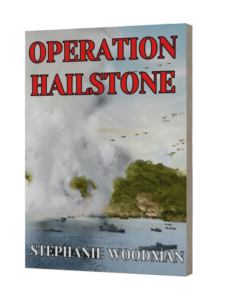
Download your free novelette OPERATION HAILSTONE— the exciting prequel to the novel EYE CONTACT OVER TRUK—and join Stephanie’s Readers Club for occasional newsletters with giveaways and book updates. You will not be spammed and, of course, you may unsubscribe at anytime.